Sunday, 8 April 2018
Sunday Short - Non Specific Accessibility Aids
This post first appeared on Tumblr earlier this week. I was initially hesitant about posting this because that would be three disability Sunday Shorts in a row. But I decided to go for it because it's an important topic
For ridiculous reasons I have been without a mobile phone for two months now which is infuriating.
I haven’t been able to afford to buy a replacement and I have lived in hope that the place I sent it to get fixed would actually return it. That’s a whole other story though.
The thing I don’t think people realise is actually how disabling this is for some people. I know there are all sorts of stereotypes and prejudice about The Youth and Their Addiction to Screens which largely is bullshit. The truth of the matter is that for modern life, especially for people brought up with the tech, smart phones are incredibly useful. They can keep you in touch with people, you can conduct web searches, you can easily check your bank balance when you are out, you can check Google Maps for directions, use it as a train ticket and so so much more.
For pretty much anybody of any age ho uses a smart phone regularly, being without one for a protracted period of time is an inconvenience at best. We can’t deny how useful they are.
But I want you to consider that usefulness and expand it a bit further.
I want you to consider it as an accessibility aid for disabled people.
Consider somebody who has sevee anxiety or autism and who struggles being out, especially in busy places. Their smart phone has apps that can help to calm or distract them, it has music, audiobooks, meditations or white noise to drown out or distract from excessive stimuli. It can help communication if you struggle talking to other or can bypass stressful communication altogether for example by giving you directions instead of having to ask a stranger. Most importantly for many it can allow you to contact somebody you know and trust either to come and pick you up/help you or just to keep you calm and centred while you manage yourself.
Consider the person with ME who gets struck with excess fatigue or pain while out. They can use their phone to look for the closest taxi rank, bus stop or to order a taxi because they cant walk anymore and aren’t safe to drive. They can use apps or google street vie and similar to find the nearest bench to sit. They can use their phone to communicate to people f the fatigue effects their speech. They can use apps to check when they last took meds and when it’s safe to take another dose. Again, they can call for support, help and guidance when they are so exhausted they can’t think clearly.
Consider the person who is partially sighted who can use apps to magnify text on labels and packages or to read out loud signs. They can have spoken directions to navigate a busy town centre. They can use the bus services app to get a ticket so they don’t have to try and see the coins and ticket machine when travelling.
There are so many different ways a smart phone can help disabled people access the world around them. They are useful for pretty much everybody but they can be the thing that makes the world actually accessible to others. But a smart phone isn’t considered an access aid. You’ll never get government funding for a smart phone no matter how useful it is to a person.
There are so many other everyday objects I could have used as an example - a hand blender, a microwave, a laptop or tablet, a “fancy” one cup kettle- but also a pre booked seat on a train, first class on a plane (for the leg room amongst other things), taxis, specific housing.
We have to stop seeing access aids as medical devices that are prescribed and start recognising that what might be a convenience to you, an able bodied person is actually a major help to a disabled person. We need to do this to reduce disableism, increase accessibility and to realise that things like being without a phone isn’t always just a minor annoyance.
This is what is often called a “disability tax” - the extra costs that disabled people need to pay in order to have normal access and a normal standard of living. What is a non-essential item or a perk to an able bodied person is virtually a necessity to a disabled person.

Sunday, 1 April 2018
Sunday Short - this is systemic disableism
This post first appeared on facebook on 24/03/18
This was inspired by the HuffPost article BBC Journalist Criticises Heathrow Airport's Treatment of Disabled Passengers
You need to think about accessibility right from the beginning and have accommodations for disabled people as seamless a feature as any service you offer to literally any other customer. If you are designing services or features for your customers you have to include all you customers able bodied and disabled right from the start because if you don't the chances are your accommodations won't actually accommodate. A disabled customer, client, or service user is no lesser than any other customer. They are not a subclass, or different species. They are people who should be valued equally with your able bodied customers. And that means you don't lose a wheelchair.
This was inspired by the HuffPost article BBC Journalist Criticises Heathrow Airport's Treatment of Disabled Passengers
— Frank Gardner (@FrankRGardner) 24 March 2018This is what we mean by systemic disableism. Having guidelines or systems or accessibility features is all well and good but they have to work. You have to be able to use them smoothly and effectively. If they are an afterthought, addition, or hidden away in the back of a training folder they aren't actually accommodations.
You need to think about accessibility right from the beginning and have accommodations for disabled people as seamless a feature as any service you offer to literally any other customer. If you are designing services or features for your customers you have to include all you customers able bodied and disabled right from the start because if you don't the chances are your accommodations won't actually accommodate. A disabled customer, client, or service user is no lesser than any other customer. They are not a subclass, or different species. They are people who should be valued equally with your able bodied customers. And that means you don't lose a wheelchair.
You can read more about my thoughts on this issue along with more examples in this article: Your Accessibility Needs to Be Accessible
If you like what I write and want to leave a tip you can do so at ko-fi.com/axesnyarn
More than that it's what I use to write for my blog Axes'n'Yarn and to run access:LARP. I have a very very small income through access:LARP but without the laptop I couldn't even earn that! Any contributions to my new laptop fund (or let's be honest, a refurbished laptop fund) are greatly appreciated as I am not sure how I can afford a new one right now and I am scared of loosing my connection to the world. I'm not aiming for a super fancy high end gaming laptop, my needs are fairly modest. I just need something that works, actually charges and keeps me connected.
Laptop Fund
My laptop is on its last legs. It has recurring power issues, is starting to crash more frequently and is doing some weird stuff. Though I have an old back up laptop it is old and has its own problems and doesn't run some of the programs I need. I am disabled and often stuck at home: my laptop is what keeps me connected to the world. I use it to talk to friends and family, see what is going on in the world and to learn.More than that it's what I use to write for my blog Axes'n'Yarn and to run access:LARP. I have a very very small income through access:LARP but without the laptop I couldn't even earn that! Any contributions to my new laptop fund (or let's be honest, a refurbished laptop fund) are greatly appreciated as I am not sure how I can afford a new one right now and I am scared of loosing my connection to the world. I'm not aiming for a super fancy high end gaming laptop, my needs are fairly modest. I just need something that works, actually charges and keeps me connected.
Sunday, 25 March 2018
Sunday Short - Being Disruptive is Necassary
Sunday Shorts will be brief blog posts often drawn from things i have posted on other media such as facebook or tumblr.
 |
| Screen shot of a tumblr post - an anonymous question to user beeth0ven and their reply. Transcript below. |
anonymous asked:
I def get the cripple punk movement and on the other hand the entire thing is a little to Malcolm X and not enough MArtin Luther for me.
beeth0ven answered:
mlk is so often misquoted and taken out of conext by white people. MLK wasnt just "we are equal lets be peaceful" guy - knew that the apathetic white was the biggst danger of all, he knew capitalism was an evil. he said plenty of things they don't teach you in school.
You also act like malcolm x was wrong in some way. this movement isnt for you. it's not for able bodied people. sorry to hurt your feelings.
My response:
What you mean when you say this anon, is that you want to humour disabled people but not actually listen. You are happy to give people the opportunity to speak but not to make waves. You think it is sufficient for people to complain and say things suck but you are not prepared to make actual changes. You want to feel like an ally who supports disabled people but you don’t want to change the status quo or move out of your comfort zone.
Disabled people need real changes and they need real support. That’s going to shake you out of the status quo and it’s going to feel disruptive but that’s not a bad thing. That’s a positive thing because it is a sign of change.
You think the soil doesn’t get disrupted when a plant shoots? You think the plant is ad or amoral for growing?
You are the soil. We are the plants. We are growing and you will be disrupted. But it’s either that or you keep us suppressed underground.
Find me @skeletonmug on tumblr
If you like what I write consider leaving me a tip buy donating via ko-fi.com/axesnyarn
Wednesday, 21 March 2018
Wakanda - My Solarpunk Dream City
Or another reason to love Black Panther
At the time of writing Black Panther has been out at the cinemas for a good few weeks. It’s understandably got a lot of attention and most of it deservedly positive. Chances are, if you are reading this you have seen the film.However this is not a Black Panther Review as such. This is me focussing on a very narrow aspect of the Black Panther themes and aesthetic. Because as well as the awesome representations, amazing female characters and strong ethical and moral themes, the entire design and concept of Wakanda was incredibly exciting especially to somebody who is a solarpunk and architecture nerd.
 |
| Screen-shot from Black Panther. the image shows a futuristic city from above surrounded by mountains. there are a number of skyscrapers of varying shapes and designs. The central tower has a large circular building spiralling around it. |
About Solarpunk and Afro-Futurism
So to begin, let me just explain a little about solarpunk. Solarpunk is a movement, aesthetic and literary genre that embraces eco friendly, eco-integrated technology in a futuristic setting. It generally envisions a utopia or at least a functioning balanced society rather than a dystopia. At its most basic it is a style and aesthetic involving natural elements like plants, water, wind and sun alongside slick futuristic technology and building. More in depth it is an entire movement and way of thinking that people aspire to and is a goal to work towards not just in terms of technology but socio-politically envisioning a low impact society that provides opportunities and equality for all citizens.
Solarpunk is also closely tied to Afro-Futurism. Afro-Futurism is again simultaneously an aesthetic, a literary genre and a social movement. In brief it grew out of a desire to re-centre sci-fi away from white European style and social constructs. Authors from Africa were creating bold and beautiful sci-fi novels based on their own experiences and cultures and ignoring the “tradition” of sci-fi (and fantasy) being largely dominated by the white Western world which was heavily influenced by historic Europe. Additionally it seeks to draw on current and emerging technology and architecture from African countries. In doing so it challenges the narrative of “Africa” often seen in Western countries that tends to homogenise the entire continent and skim over the modern, functioning and often socially forward cities and countries in Africa focussing instead on wildlife, famine and seemingly less developed tribes.
Afro-futurism by its nature often encapsulates solarpunk ideals and aesthetics focusing on new technologies that work with or make use of natural resources in a sensitive and sustainable manner whilst respecting the cultures and needs of citizens.
So then to Black Panther or more specifically, Wakanda. If you have seen the film or to be honest just seen pro-mo pictures then you may by now have an inkling of why Wakanda and Solarpunk are related. The design of Black Panther’s Wakanda is down to Hannah Beachler, the head production designer for the film. As an aside, Beachler was strongly influenced by award winning architect Zaha Hadid and her iconic modernist designs who I happen to be a fan of. Beachler was also inspired by the Afro-futurist movement as well as the incredible real life modern and traditional architecture of a variety of African countries.
It’s worth noting that, while it’s generally not a good idea to refer to Africa in such a way as to imply one giant monolithic homogenous culture, in the case of Wakanda and Afro-futurism, it makes sense. Afro-futurism positions itself as thematically different to European sci-fi and is a pan-African phonemonon not restricted to any one country plus it deals in fictional creations. Additionally Wakanda itself being a fictional state which exists outside of colonialism and some may argue, represents a “heart” of Africa that brings together a number of different cultures and traditions. Essentially there is no single country to reference when talking about these subjects.
Seen through this context then it’s clear why the Wakanda on screen was a dream come true for an aficionado of Solarpunk or Afro-futurism. But it’s not just because it looks pretty, though it certainly does. The real excitement, for me at least, was the variety and thoughtfulness of the design.
Considering your environment
Solarpunk art often falls into the trap of envisioning the same soaring towers of class and metal alloys covered in plants, solar cells and wind turbines. Accasionally you get some divergence to stucco covered Gaudi like organic structures that sweep and curve around a city. This is a trap because it is missing some of the core ideals of solarpunk design and ethos – that people should live a live which is both in harmony with the world around us as well as living in a sustainable and equal society. The thing is, every environment, country, ecosystem and area is going to have very different needs when it comes to living that solarpunk life. At its most simple we can see this in everyday housing design. Most people in Queensland, Australia for example have houses built to maximise ventilation and minimise glare from the sun. Many houses don’t have any real sort of heating system because it’s simply not needed and insulation would not only be a waste of money but could lead to dangerous overheating. Put that house design in the UK and you are going to have cold, damp unhappy residents. Here we need buildings with thick walls, plenty of insulation, large south facing windows to maximise light and smaller north facing windows to stop us getting chilly – though we do share the need for ventilation to prevent endless damp.Futuristic architecture and sci-fi technology doesn’t do away with this need to be cognizant of our surroundings and in solarpunk I would say the need is even greater if we want to achieve the near utopian levels of harmony the genre aspires to. But while this is where some solarpunk falls down, it’s where Beachler’s design excels. By drawing on existing architecture and emerging African technologies for her design, she created a Wakanda that works well and integrates into its environment with harmony.
The Importance of Traditional Buildings
Traditional architecture is generally a good place to start to look for simple architectural techniques that make the most of the environment, and this is no different in Africa. In Wakanda this is most obviously seen in the village of the Border Tribe who mostly live and work out of what would be recognised as “traditional” houses made of mud and wattle with thatched roofs. The buildings are cylindrical with conical roofs – similar to those found in Rwanda, Lesotho, Kenya and many other areas - and small windows. They keep the daytime heat out and keep you warm at night. But traditional design isn’t restricted to the “simple living” of the Border Tribe[1], its influence is in the central city as well. |
| Still from Black Panther. Image shows a bustling street view looking down a wide road. There is a futuristic road-train in he centre, the buildings are varied in size and material. |
There are a number of buildings in the city that would appear to be made out of mud or clay walls albeit finished with more modern or technologically advance roofing. In other areas of Africa, for example Ghana and Mali, a number of traditional buildings are made from sweepings curves with mound shaped columns supporting the walls and roofs. They are incredible and beautiful structures, made of ingenious shapes that make the most of natural resources. Tin some cases these walls and towers are strengthened by horizontal beams and rods that project through the outer surface making them bristle like a hedgehog. Again these basic shapes and materials make their way into the fantastic and solarpunk Wakanda on screen.
 |
| A close up photo of an ancient mosque in Ghana. The building as tall mound shaped pillars with wooden spurs protruding through the clay. |
This integration of traditional techniques, using local materials and building methods that are sympathetic to the local environment in order to reduce overall impact is an essential part of solarpunk design and one that is often over looked.
Modern Architecture is Complex
All that being said, Africa isn’t a continent made up solely of traditional buildings and basic living. Like any other continent on Earth it has its share of modern cities and busy urban spaces. Here we need to consider the general history of Africa and how it fits in to modern institutional racism and what that means for solarpunk. Large parts of Africa were invaded and colonised by European countries. Many of the borders we recognise today were not “naturally occurring” (if any can be said to be) but the result of colonial intervention and war. Additionally architectural styles from the 19thC onwards have been heavily influenced by European settlers as well as mass globalisation and the spread of capitalism. European settlers had specific ideas about what houses and buildings looked like, and though their usual stone and brick wasn’t available they strove to recreate this facsimile of European architecture in the land they had colonised. This wasn’t always successful; as noted these building designs aren’t always suitable for the local conditions.However it wasn’t all a disaster and fairly quickly European building design was adopted. The rapid increase in global markets and the post-colonial atmosphere of the mid 20th Century accelerated building and development of cities. What was peculiar was the flourishing architectural style of many African cities was still dominated by white European or Israeli[2] architects. Rapidly developing African countries where the perfect setting for radical brutalist and modernist designs of the 50s and 60s. While this undoubtedly fit in with the psyche and mood of the time it does mean that a lot of the modern African architecture that is held in high esteem has a complex history in which it is the product of post colonial colonialism. Indeed for a period there was a lack of non-white “modern architects” as opposed to merely people who build buildings, who originated from African countries as those subjects weren’t taught widely outside of European universities and/or there was segregation acting as a barrier.
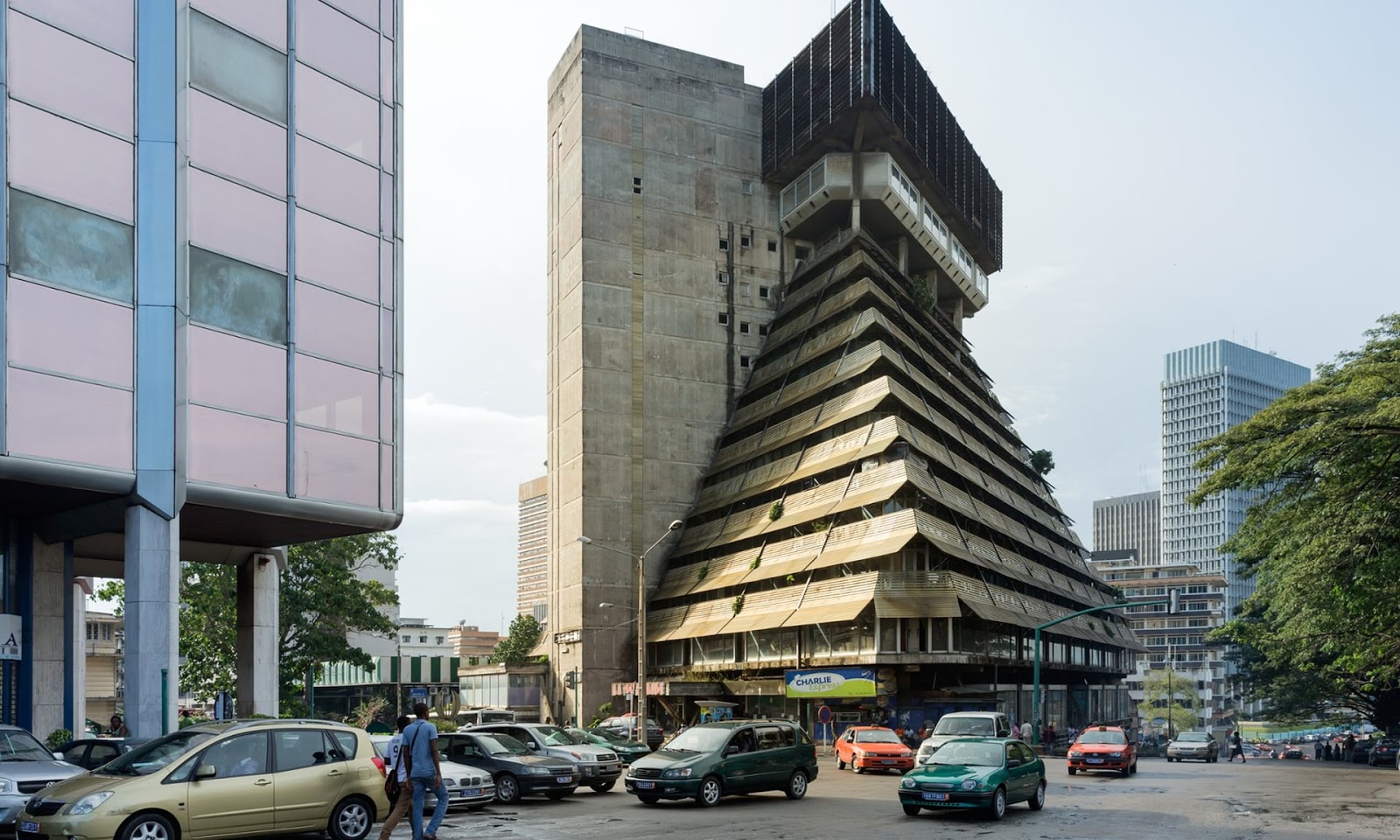 |
| Photo by Iwan Baan of La Pyramide in Abadjan, Ivory Coast. The photo shows a large modern building made of concrete and shaped like half a pyramid attached to a tall rectangular tower. The building shows signs of disrepair. |
Why do I bring this up in so lengthy a manner? Well it’s because of the values and ethics that are a part of solarpunk. Most people who are into solarpunk would agree that solarpunk societies are diverse and equal, free of prejudice and, not uncommonly, free of Western neo-capitalist ideals. That means that when designing and creating a solarpunk city, especially one that is not located in a European country, it is essential to examine the influences and origins of your design. If your design relies heavily on that of white Europeans for a city in central Africa then not only is it likely that it would be ill-suited stylistically and functionally but you would be ignoring the issue of colonialism and systemic racism. This is the case whether you are envisaging a potential real world future or creating new fictional spaces, because even fictional spaces are influenced by the real world.
In the case of Wakanda and Black Panther there is a thread running throughout the film (and I promise this is not a spoiler) that questions globalisation and colonialism and their impact on non-white, non-European countries. That the architectural design reflects this is a beautiful thing. It shows a level of awareness and consideration that is often neglected in solarpunk and sci-fi design (though I would bet good money on it rarely being left out of afro-futurism).
The modern, futuristic and high tech design of Wakanda does draw on the influence of non-African architects that’s for sure: as noted at the beginning there, Zaha Hadid was stated as a major influence and she was Israeli. But those designs have been chosen with consideration of the real world source material and what including those designs implies for a solarpunk dream city. In the cases where European designed buildings have been referenced they are those which have been embraced by current societies and have integrated themselves into modern cities and are still functional. To many of the 20thC brutalist structures were never completed or were abandoned when they proved unsuitable for their environment. Instead it is more recent architecture, both by African and non-African architects that has been referenced as modern African architecture is far closer to solarpunk ideals than its predecessors. It’s in African cities that you will see some of the most cutting edge uses of materials, inspiring design and forward thinking sustainable and eco-friendly building. Not only is that a part of the solarpunk ethos, it is the way of life of Wakanda.
 |
| Photo of the Leo Surgical Centre Designed by Francis Kere an architect from Burkina Faso. The image shows a wide walkway between rows of adjoining buildings the buildings have open roofs and wide overhangs. |
That Bechler managed to integrate the traditional features and techniques with cutting edge design and modern and sci-fi technology is to be applauded. This is how Sci-fi and solarpunk cities should work. I wouldn't say it's how they should look because if there is anything you take away from this it's that solarpunk cities should be defined by their locale. But it is how they should be formed: seamlessly blending traditional and simple with new and high tech. Creating a city that is free of structural inequality and reflects the idealised social structure of your solarpunk world. In Wakanda the streets between the clay and vibrinium walls are wide and easy to pass through, there are no cars but plentiful public transport systems. there are places to sit and buildings can be entered into easily. The space is built for the people who live there and works with the environment around it to remove any social barriers whether they be from outside influence or physical ability. It is harmonious not just in society but in it's very structure.
And that, is why Black Panther was an exciting film to watch for any solarpunk, architecture or afro-punk enthusiast. Ecologically smart, location sensitive novel design.
 |
| Still from Black Panther showing the mountain headquarters of the Jabari Tribe jutting out of the mountainside. Included because it was my favourite piece of design. |
[1] The simple living of farming war rhinos and defending the border.
[2] In the mid 20th Century several African nations had strong diplomatic relations with Israel which supported various anti-colonial and independence movements. The agreements were damaged in the 1970s due to the Arab-Israeli war, limiting foreign investment and development.
Thursday, 1 March 2018
The Sketchbook Project
The past few months I have been working on improving my drawing skills. In order to encourage myself to draw regularly I decided to participate in the Sketchbook Project.
This is a project set up in New York that aims to act as an archive and library of artists from beginner to professional. You simply fill up one of their sketchbooks, send it back to them and it becomes a part of their collection free for members of the public, schools, art and community groups to browse.
What I particularly like is that, while for me as a random member of the public I had to pay for the book, the sketchbook is sent free to schools and community groups who wish to participate. This makes art and participation n pubic arts projects far more accessible to low income people and not-for-profit groups. Greater accessibility to the arts is something I strongly support - art shouldn't always be treated as a luxury or as something only other people do. It should be something that all people regardless of background or current financial status feel they can be a part of.
This, somewhat shaky and poorly filmed video gives you a walk through of my sketches, the things I have learned and how I have developed my drawing over the past few months. (video is subtitled in English)
If you like sketching or painting or want to do more art, I would definitely recommend considering getting a Sketchbook Project book to fill in and to contribute to the project. I found that being part of a bigger project was a really great motivation to pick up the book and draw even on days I might not have felt like it otherwise.
 |
| Photograph of an A5 manila envelope with the heading "The Sketchbook Project" balanced on a person's knee with a tin of pencils balanced on top |
This is a project set up in New York that aims to act as an archive and library of artists from beginner to professional. You simply fill up one of their sketchbooks, send it back to them and it becomes a part of their collection free for members of the public, schools, art and community groups to browse.
What I particularly like is that, while for me as a random member of the public I had to pay for the book, the sketchbook is sent free to schools and community groups who wish to participate. This makes art and participation n pubic arts projects far more accessible to low income people and not-for-profit groups. Greater accessibility to the arts is something I strongly support - art shouldn't always be treated as a luxury or as something only other people do. It should be something that all people regardless of background or current financial status feel they can be a part of.
 |
| photograph of an open text book on the left showing an upside down Picasso sketch and an open sketchbook on the left showing my pencil copy of the sketch |
This, somewhat shaky and poorly filmed video gives you a walk through of my sketches, the things I have learned and how I have developed my drawing over the past few months. (video is subtitled in English)
If you like sketching or painting or want to do more art, I would definitely recommend considering getting a Sketchbook Project book to fill in and to contribute to the project. I found that being part of a bigger project was a really great motivation to pick up the book and draw even on days I might not have felt like it otherwise.
Tuesday, 13 February 2018
Names, identities and hats
The eagle eyed of you who have followed me for some time may
have noticed that while the blog name has stayed the same, my name has changed
a couple of times. I guess name changes aren’t all that unusual on the internet
but I think it’s time I told you why, and why it shouldn’t be changing again
for a long while, if all goes to plan.
Hi, I’m Robin, I’m non-binary and agender.
So that line sums it up pretty well and I guess I could
leave it there. But if I was in to perfunctory statements I wouldn’t have this
blog.
First of all what does this mean. Let’s get some things
about gender straight. Gender is a social construct. It is a method of
labelling ourselves and others that was created within our culture and is
shaped by our cultural norms and history. That’s why in different parts of the
world the exact definitions of gender and the labels available can differ to
our own. What we think of as masculine and feminine isn’t fixed from culture to
culture.
But that also means that genders aren’t fixed definitions
and it doesn’t have to be a binary state of male or female. There are many
people who do not identify with either purely male or purely female and instead
feel like they are something else. This is being nonbinary – existing outside of the commonly used binary system we
have in Western culture. I should emphasize here that this isn’t just “not
being like other girls” or “I’m not really one of the lads!”. While those experiences can be a part of the
nonbinary and trans experience they
aren’t the whole deal and can and do form a part of the identities of people
who have binary gender.
 |
| Pencil sketch of me by Jennie Gyllblad |
How do you know then that you are nonbinary?
Honestly I
can’t say. How you identify is personal to you. So let me tell you how I know
and the process I went through.
This is a story of two halves and like the most edgy of
modern fiction I will start with the latter half. Though I had heard the term
nonbinary (NB) before and knew that there were people who were neither male or
female, it was only a few years ago that it was a concept I really started
engaging in and thinking about. I had a couple of friends who were nonbinary or
who came out as NB and I found that it was entering into my sphere of awareness
online more and more. It was the first time I really started to think about it.
Listening to other people’s understanding and lived experience was key as there
were a number of instances you could term “light bulb moments. Tiny light bulbs
maybe but still, something in my brain was clicking in to place and saying “oh,
that sounds familiar. Interesting”.
Additionally this exposure to conversations on gender
encouraged me to consciously think about my own gender identity and what it
meant to me. This is something I would encourage people to do, even if you are
comfortably binary or cisgendered (or cis, means that you identify with the gender and sex assigned at birth).
Because we can only really know our own feelings about identity it is
very easy to assume that what we feel is the default and that this is what
everybody means when they say “I am female” or “I am male” or even “I am
trans”. It can be a good exercise in self awareness to actually examine a
little more closely what you mean when you think and feel these things and to
consider them in comparison to other people’s experiences.
When I examined my own identity in this way I came to
realise that actually I was nonbinary and it was a term I began to use to
describe myself with close friends.
Now to go back in time to the first half of this process:
this process of examining my own identity lead me to consider some of the
experiences I had had since I was young. I reflected that I had always bristled
at being described as a girl, female, lady or woman. It had been easy to
dismiss this when I was a teenager: girl was too childish whereas woman felt
too mature. “Female” can be oddly condescending and lady has implications of daintiness
and certain feminine behaviour I didn’t embody. But I knew that while partially
true, they had always been excuses, easy vocalisations of a deeper discomfort
with being labelled as those terms.
I had, like many people my age, gone through a phrase of
saying “I wasn’t like other girls” and “I was more one of the boys”. Now these
phrases are trickier to unpack. There are definitely influences of patriarchy
and internalised misogyny – when media shows women as weak, frivolous, vapid,
dumb and generally lesser it’s not surprising that many young women (or people
labelled as female) choose to push against this and distance themselves from
the term. That was without a doubt part of my experience, but on reflection I
was able to see that there were times I said “I’m not like other girls” because
I wasn’t like other girls. I was struggling to identify with “girls” as a group
and often felt like an outsider. I should note here that I went to an all girl
school. There was a lot of opportunity for me to feel like an outsider and
gender was only a part of it. But it was a part of it.
Let’s return to sexism and misogyny for a moment. Do you
know how deeply frustrating it is to be the subject of mysoginistic slurs, or
grouped in to statements like “well that’s what women are like” when there is a
part of you, deep down and unvocalised, that knows you aren’t a part of that
group? When I say “I’m not like that” it’s not just because I am rejecting the
slur, the insult and the sexism, it’s because you’ve not seen who I am. You’ve
grouped me in with a group you hate and I’m not even part of it.
There had been a little voice inside me, angrily shouting
for decades, “that’s not me!” but never really understanding what that meant.
If asked I wouldn’t have been able to tell you why I thought that but it didn’t
make it any less present.
Associated with this was how I felt disconnected with
various feminist movements. From Girl Power in the 90s to contemporary feminism
I had often struggled to connect with it. While I could feel with a deep
passion that they were needed and important, after all I had experienced
first-hand many of the issues being dealt with, when people would put out a cal
to women, or ask women to band together, I once again felt that vague sense of
being an outsider. It wasn’t the naive “I’m not like other girls” any more but
it was a “is this for me?”. The stronger the message of women banding together
the more I felt excluded even though, to the best of my knowledge at that time,
I was part of the target audience. Anything related to Breast Cancer Awareness
was of particular discomfort and felt like a personal affront such was their
all female message so strong.
Back to the present day, or at least those days a few years
ago when I was exploring gender identity and a good friend said to me “When I
get called girl or woman it feels like a cat having their fur stroked the wrong
way.” . That was it, the final little light bulb in my head. That was the feeling.
What I found interesting is that when I thought about being called male, boy,
man or lad, it felt just as alien to me. Maybe not as aggravating because it
didn’t have decades of lived experience and associated sexism attached, but
still distinctly wrong. I was then fairly sure I was neither male nor female.
At first I started using the term nonbinary or NB, which can
be a nonspecific umbrella term and genderqueer, which was a little more
specific and is generally agreed to mean a nonbinary identity that mixes
different aspects of feminine and masculine without being either male or
female. Bit by bit I started talking
about this to different friends and using it as my identity and it felt good. I
felt calmer and more sure of who I was than I ever had. I no longer had the
feeling of being slightly out of synch with what people thought of me. Over time
I have come to use the term agender as well. Agender essentially means “outside
of gender” or to not have a gender as understood by our cultural definitions. I
am still fairly flexible on which terms I use.
Just as I had always had this vague feeling of being slightly out of synch with how people saw me, I had always felt somewhat that my name wasn’t quite right. The name I was given at birth was Sophie. It’s a lovely name, with a rich history. It is a name to be proud of and treasure associated with wisdom and inner strength. I honestly do think it’s a beautiful name.
But it was never my name.
 |
| Picture of me from 2011(ish) with cropped blonde hair and a vintage black hat |
The hat analogy
The analogy I use I use is hats that don’t fit.
Imagine you have been given a hat as a gift. It is beautiful,
majestic, and handsome. But it doesn’t fit. Whenever you wear it it’s a little
uncomfortable, maybe it doesn’t balance properly, always feels like it’s about
to fall off, and maybe you worry it looks faintly ridiculous on you. It doesn’t
stop it being a really nice hat, and one you are thankful for being given, but
that doesn’t make it fit any better.
Now for some people you might be able to alter the hat,
tighten the hat band and it fits better. That would be those of you who shorten
your name or go by a nickname. The Robs and Steves, Kats and Dannis. You aren’t
a Robert or a Bob, you are a Rob. You aren’t a Katherine, or a Cathy, you are a
Kat.
But for some of us the hat can’t be comfortably adjusted or
forced to fit. It still just balances awkwardly on your head making your
faintly uncomfortable. Then one day you find another hat. You try it on just to
see. It’s different to your first hat, but still pretty nice. But this one
fits. This one is comfortable and stays on your head. You can wear it and not
worry about it falling off or hurting. That’s what it was like when I started
going by a new name. I originally chose Penn. It definitely fit me better than
Sophie. It was easier to wear.
The thing was, though I used that online and amongst friends
for over a year it still never felt quite right. I liked it but it wasn’t
completely me. I knew I wouldn’t stick with it when I decided if I wanted to formally
change my name. Even though I was increasingly irritated to have to use my
original name in official places, I was reluctant to change to Penn.
I went looking for a new hat and I found it. Robin is the
hat that has the right look. It suits me, it fits, it’s comfortable. Somebody
else can wear Sophie and it will be the right hat for them. Bot for me, Robin
is the hat that fits.
Now to clear up a few points
Am I trans? Technically yes. Trans is the abbreviation of transgender which has the accepted definition of “a person whose sense of personal identity and gender does not correspond with their birth sex.”. In our society we take the sex assigned at birth, male or female, as the assigned gender. If you identify as NB then you don’t identify as the sex assigned at birth since it’s not even an option. By that definition a person who is nonbinary is transgender or trans. A lot of nonbinary people choose not to call themselves trans as their experience is different to people who are transgender within the binary, that is to say male to female (mtf) or female to male (ftm) transgender. Because the common usage of trans generally refers to people who are mtf or ftm many NB people feel that the term doesn’t include them. Equally some people who are mtf or ftm prefer that NB people don’t use the term trans as it can confuse and complicate the issues they are dealing with.
Personally I fluctuate on whether I use it or not and it
often comes down to context. In general conversation I tend not to use it
because of the common usage described above. However in some conversations and
spaces it is appropriate for me to use the term trans. For example in
conversations that are about the experiences of people who are not cis it is
appropriate to use the term trans. I also participate in a trans and nonbinary
swimming club and am happy to use the term trans when there as everybody there
understands the terminology as well as personal experiences.
Understandably because the words
have similarities people sometimes think trans means “transition”. What a lot
of cis people mean when they say transition is medical or surgical
transitioning – genital surgery, breast augmentation or reduction, and hormone
therapy. While these are routes that many trans people take they aren’t
universal experiences even among mtf and ftm people. It’s a very personal
decision involving some pretty major medical intervention. Some people may take
it up whilst others choose not to or are unable to due to other health issues.
The issue is even more complicated with nonbinary people who (like binary trans
people) may experience little or no body dysphoria and don’t necessarily want
to change their body. Some people who are nonbinary do undergo some medical
transitioning, whilst others don’t. However it is a very personal issue and one
that nobody is obliged to disclose to anybody.
What about presentation, and do I still look “female”? Well
that depends on what you think female looks like really. Generally I am read as
female. My particular body and face shape is associated with “female” in our
society. Because it is acceptable for women to wear more masculine clothes
(jeans and a sweater for example) but not for men to wear women’s clothing
(dresses and blouses) even if I dress in a “masculine” fashion I am often
referred to as female. This is aggravating but there is little I can do about
it without a concerted effort. Additionally because our culture has developed
the attitude that “male is default” there is a tendency for people to conflate
“androgenous” or neutral clothing with male clothing. As I said earlier, I
don’t want to be male. I’m not male. I shouldn’t have to make myself look more
male in order to be not read as female. It’s frustrating. Plus I like leggings
and skirts. They are comfortable.
However, and I want to make this very clear: I am not
presenting as female. You may read me as female, and our society may associate
parts of my appearance with femininity but that is not deliberate on my part. I
am presenting as me and as nonbinary.
What do I call you? Robin. Or another nickname I guess. My
pronouns are they them by preference but I don’t mind she/her, especially if
you are my grandfather. I am not a girl, woman, lady or female or other
gendered terms (again unless you are my grandfather or we have talked about
it). If for some reason you need to state my gender you can say NB, genderqueer
or agender.
But what is my sex? Usually when people ask this what they really mean is "what are your genitals". Honestly that’s none of your business.
You can probably work it out if you need to. But really you don’t need to.
Tuesday, 23 January 2018
Cripple-Punk: when existing is rebellion
Cripple-punk, Chronic-punk, C-punk. Maybe you’ve seen these
terms around, maybe you haven’t. But what do they mean?
 |
| [image description: a digital artwork depicting user ogrefairy - a fat light-skinned wheelchair-user with a “The Future Is Accessible” crop top, surgery scars on her knees, reddish-purple lips, thin framed glasses, a dark brown bob cut, and a floral tattoo on her wrist. She is giving a peace sign and a gentle smile while sitting in a manual chair that has been decorated with purple and black zebra patterned tape. Matching forearm crutches sit behind her backrest. The background is Art Nouveau inspired abstract pale purple with a floral wreath of princess lilies and has flowers that match those on her tattoo. The whole image gives off a gentle, soft tone with layers of maybe assertive resilience built in.] |
Cripple-punk can be described in a number of ways: a
movement, an attitude, a lifestyle. It is all of these things. Tired of being
pitied, portrayed as weak, incapable, lesser, and tired of being treated as
fragile adult children disabled and chronically ill people are fighting back.
Part of this fight is the reclamation of the word cripple once used derisively
for those with mobility issues; it is now being said with a self aware pride by
the very people it refers to. “Yes I am a cripple. What’s your point?”.
Of course not everybody identifies with the word cripple.
For many it is still a word that carries social stigma and negativity, and for
others it just doesn’t reflect their personal situation. So then the terms Chronic-punk and C-Punk. From this point
forward I will be using the term C-punk inclusive of both cripple- and
chronic-punk.
Let’s turn briefly to the history of punk itself. Whether
you believe that punk was spawned in the clubs of New York or the streets of
London, what is clear to all is that punk was a reactionary movement. Punk
developed as a reaction to and rejection of the orthodoxy. It was a rebellion
against the sociopolitics of the mid 70s and 80s. It embraced anarchy,
nihilism, dada, socialism and did so with an unbridled and shameless energy and
aggression. It was a challenge to everybody to embrace individuality and push
against normality.[1]
Since its initial inception as a subculture there have been
numerous off-shoots, and further subdivisions such as hardcore punk, post punk
and even pop punk that grew organically out of the original punk scene. Later,
the term punk was used as a suffix for a number of sub-genres and cultures
which were about subverting, challenging and changing the status quo of a given
theme. Thus was born steam-punk (subversion of Victoriana), diesel-punk
(mutations of the early 20th century), cyberpunk (subversive sci-fi
and near future), and more recently solar-punk (eco futurism) and afro-punk
(referring both to the contribution of black people to alternative and activist
movement AND to a variety of solar punk that is centred on African culture
related to afrofuturism[2]).
These subgenres are largely arts based, developing from literature in to art,
music, lifestyle and “aesthetic”. [3]
 |
| [image description: a digital artwork depicting a black person with short black dreads on the top of their head that are died orange at the tips. They are wearing short gray shorts that show pockets and a white bikini top and white lipstick. She has artistic, white prosthetics on her left arm and leg that are decorated with orange day lilies. The background is pale blue with a floral wreath of orange day lilies. They are muscular and seem to be very confident.] |
Now that we have a mutual understanding of punk, let’s think
about C-punk. If punk is about rebellion, subverting the norm and individuality
how does that apply to chronically ill and disabled people, after all people of
all backgrounds can be disabled? While that’s correct there are common
experiences shared by many people with disability and chronic illness.
Disability is rarely seen in media and when it is it is often a feature of a
storyline designed to generate sympathy or as a growing point for an able
bodied character. When characters are disabled that is often the primary focus
and the character is allowed little characterisation or identity other than
their disability. This spills over in to everyday life for many people – people
with disabilities and chronic illness are often forgotten about (as evidenced
by many buildings and events not thinking about accessibility at all) or
reduced to a stereotyped collection of their symptoms and abilities. In real
life it is common for people to be ignored, talked down to or infantilised as
if any single impairment is enough to strip a person of their faculties and
individuality. There is a stereotype that disabled people are either meek and
quiet, eternally grateful for the things they can do and any shred of
recognition they can get or, alternatively, we are bitter and remorseful,
struggling to cope with our limitations and desperately wishing we were able
bodied. There seems to be some sort of shame or guilt from able bodied people
that encourages them to hide disabled people behind the curtain, because they
don’t know how to treat them. This is lodged in the idea that a disability or
chronic illness makes us somehow “other” and reduces us to a small set of
experiences specifically linked to our health. It forgets that even though
disability or chronic illness may be a big part of our lives (and trust me I
can spend hours talking about health symptoms and medical research) it is not
the only part of our lives and really we are as diverse as any group of able
bodied people.
These prevailing attitudes have created a culture in which
people may be ashamed to use the very adaptations, aides, medication and
devices that actually help to improve our quality of life. There is a certain
amount of stigma attached to using a walking cane, or crutches. Being a young
person wearing joint braces encourages questions from perfect strangers and
should you reveal they are for a long term condition, pity or disbelief. People
are scared to take medication especially for anything relating to mental health
or neurodivergence, but also things like pain relievers for fear of looking
“weak” or of “giving in”. [4]
Additionally, due to our current socio-political situation (in the UK and US at
least) there is a fear that if you reveal you are disabled or chronically ill
then you are faking it for benefits, scamming the system or simply put lazy.
Conversely and somewhat surreally there is also the (thankfully
shrinking trend) of photographers and film makers using the trappings of
disability – such as wheelchairs, crutches, hospital beds, and mental health
stereotypes – as a backdrop and props for their shoots and films when they want
to appear “edgy”[5]. In
fact medical paraphernalia has been a stalwart of shock and horror media since
the 19th Century, and shockingly the attitude and acceptance of this
is only just beginning to change. Once again this “others” people who are
actually disabled or chronically ill turning their daily lives into a boogie
man or piece of set dressing. In some cases it may lead to people choosing (or
being forced to in some cases) to hide their disabilities in order to avoid
bullying, harassment and stigma.
C-Punk therefore encourages people who are actually disabled
to embrace their disabilities and to show the true face of disability and
chronic illness. If the social norm and status quo is to shame and hide and to
strip disabled people of their individuality, then it is a punk act to wear a
neck brace proudly, to decorate crutches, to be seen, to say “I am here, I am
disabled, and I am just like you.” .
 |
| [image description: a group of five individuals of varying gender presentations. They are a variety of body sizes and are dressed in a mixture of styles. One individual is using crutches, one using a walking cane, one appears to be wearing wrist braces and a fourth is wearing headphones. The background is lilac with a wreath of pink and lilac orchid flowers. The title of the piece is "My MentallyIllPunk Famiy"] |
It subverts the trend of humble gratuity to both accept and
acknowledge ones illness but also to talk out about the difficulties we face.
At its most simple C-punk is an aesthetic that does not hide or diminish
disability and chronic illness and encourages acceptance or even pride rather
than guilt or meekness. But for many it is more than that. It is a socio-political
statement and a movement. As long as disabled people aren’t seen as individuals
it is easy to dismiss and ignore their rights, ignoring accessibility laws,
harassment, the stripping of benefits in a manner that the UN has seen fit to
condemn[6].
By, in true punk fashion, making a scene, shouting out being seen and being
heard cripple punk forces those who have previously brushed aside the reality
of disabled people to view us as real people; real people just like them who
may, just possibly be deserving of fair treatment.
In some cases the aesthetic of C-punk bears resemblance to
the original punk looks: it is certainly popular with people like myself who
are brightly haired and tattooed. But it is not the preserve of the alternative
millennial (yes I am 32, yes I am a millennial, I was 15 in 2000) simply being
openly, honestly and unapologetically disabled or chronically ill in public is
an act of defiance and punk rebellion in our society. Not accepting shame,
belittling, lesser treatment or discrimination is a radical and punk act.
Not all who confidently and unashamedly live their lives
with disability or chronic illness will label themselves as C-punk and some may
have never heard of the term(s). But in a world where existing as a minority is
a radical act, they are acting in the spirit of C-punk just as much as those
who bear the label. When you see somebody embodying the principles of C-punk,
take note: realise that not giving in to outdated stereotypes and pressures is
a choice and not always an easy one. We are not your inspiration but we are to
be recognised.
All illustrations are by Ogrefairy at Ogrefairydoodles on Tumblr and are used with permission
[note: If you do experience shame, doubt, frustration and other negative feelings about your chronic illness or disability that's ok. It doesn't make you any lesser or any less C-Punk, at least in my eyes. A week does not pass by where I do not feel some frustration or inadequacy over my own health. You aren't alone, you still matter.]
[note: If you do experience shame, doubt, frustration and other negative feelings about your chronic illness or disability that's ok. It doesn't make you any lesser or any less C-Punk, at least in my eyes. A week does not pass by where I do not feel some frustration or inadequacy over my own health. You aren't alone, you still matter.]
[1] https://unireadinghistory.com/2013/09/04/punk-politics-and-youth-culture-1976-84/
[2] https://www.theguardian.com/culture/2015/dec/07/afrofuturism-black-identity-future-science-technology
[3]
There are long debates to be had about how relevant the “punk” suffix is to a
number of these subgenres and many arguments about the validity and actual
definitions. That goes far beyond the scope of this particular blog post.
[4]
See this great article on disability as “inspiration” in which a lot of value
is placed on “overcoming” your personal difficulties, preferably without the
aid of medication. https://www.abilities.com/community/inspirational.html
[5] http://www.kaltblut-magazine.com/editors-pick-elizaveta-porodina/
[6] http://www.independent.co.uk/news/uk/politics/government-spending-cuts-human-catastrophe-un-committee-rights-persons-with-disabilities-disabled-a7911556.html
Subscribe to:
Posts (Atom)