Showing posts with label art. Show all posts

Sunday, 25 November 2018

On the Subjugation of Animals for Human Entertainment.


An open letter to the curator of the exhibition held in Studio 24, Leeds, 16th & 17th November.


This letter was sent to the Curator of the exhibition on Saturday the 17th November. As of today, Sunday 25th November, I have not had a reply so am publishing without a response. Should I receive a reply I will update the post to include it.


I visited the Orwell Room 103 exhibition on Friday evening and for the most part really enjoyed it and appreciated many of the pieces of art on display. There was however one piece that gave me great concern and that I want to raise with you as curator.

Sadly I am unable to remember the artists name but the piece was I believe titled "Goldfish Bowl". At first I was struck by the powerful yet simple symbolism. I also assumed that the fish was fake, an illusion created by clever painting or resin pouring, a projection or even a well made puppet. But then I realised it was in fact a live fish. That was when my appreciation of a clever piece of art became horror and disgust.

The bowl was tiny and entirely unsuitable for housing a fish of that size as it does not allow for free and natural movement. It also didn't have a filter in to provide suitable oxygen for the fish to breathe and there was no cover again restricting natural behaviour and increasing stress. This is essentially a method of slowly torturing a fish. There is plenty of documentation available about the correct care and housing of fish of this type and size, and the days of a goldfish in a tiny bare bowl as the norm are long gone and criticised by the pet industry and aquatics enthusiasts alike. This would imply that the artist conceived of the idea of using a live animal as art and either did no research on proper care and animal ethics or did do the research and dismissed it in favour of making an artistic statement.

The piece then takes on a significantly different meaning - it highlights that we as a population, as a species, as people are content with the subjugation and ill treatment of living creatures as long as we can justify it with lofty terms like "art" and "symbolism" or even a more simply "entertainment". This itself is a critique of humanity in line with Orwellian ideology and a cruel reflection of ourselves, but to subjugate and mistreat an animal in an Orwell exhibit would seem to go against the man's own ethics and beliefs.

Even if that was the intention I can not agree with it. It would be one of those ideas that is wonderful in theory but that can not be put into practice because of basic ethical considerations. If the artist was cognisant of this and that sort of statement was intentional then to display the piece without commentary, explanation or at least a disclaimer about the care of the animal is irresponsible.

It may be that every evening the fish is removed and placed into a suitable environment but I and many others would argue that even temporary deliberate cruelty toward an animal is still not acceptable. Again to do so without any disclaimer or explanation is also irresponsible as it spreads the message to people that fish and other animals are essentially disposable and to be used as any inanimate object for the will of humans without thought or care.

While much of my complaint focuses on the decisions of the artist, as curator I believe you also share responsibility here. You choose to include the piece in your show. You chose to do so without requiring disclaimer or commentary. In doing so you give implicit support to this practice. From a legal perspective there is strong argument that this breaches the Animal Welfare Act of 2006 which requires need for a normal environment, need to be able to exhibit normal behaviour patterns, and need to be protected from pain, suffering, injury and disease.

I understand that this is a very short exhibition and you may receive this message to late to be able to make alterations or remove the goldfish. However I would appreciate it if you give my comments proper consideration and issue a public statement on the matter to ensure that the use of live animals in art without the proper care or information is not considered acceptable.

I would hope that the artist is given proper feedback and critique so that this piece is a one off example and not repeated elsewhere.

Thank you for your time and I sincerely hope you understand that I appreciate and enjoyed the rest of the exhibition and that my critique is entirely meant to be constructive and informative as well as conveying my personal ethics and opinions.


Yours sincerely

Robin Tynan

Thursday, 8 November 2018

Selling Art for Lyme Disease

I have talked about my experience of Lyme disease several times on this blog. It's a big part of my life.
The 28th of October was my 7th anniversary of being infected with Lyme disease: I was bitten by the tick that infected me on 28th of October 2011.

Each year I like to do something to mark it, and if possible to raise money for Lyme Disease Action, one of the few registered charities that is both educating and supporting research into Lyme Disease.

I decided to mark the occasion this year with some art. Both the animals I chose to paint are carriers of ticks in the UK and may be carriers of Lyme Disease. The hedgehog of course holds particular significance to me as I was roleplaying as a hedgehog at the time of being bitten. Never say I don't really get into character.

Each painting started with an ink and fountain pen sketch and was then coloured with water colours before being finished off with a little more ink. While I went down a natural route for the hedgehog I decided to go a little more whimsical with the badger which is painted in a beautiful mixture of teal and magenta handmade water colour paints.

image description: painting in shades of blue and magenta of a badger.
Original Painting by Robin Tynan available to purchase for £35

image description: watercolour painting of  a hedgehog with a mottled green and brown background.
Original Painting by Robin Tynan - SOLD


Both paintings are available as prints from Society6  and all profit will go to Lyme Disease Action.

The original painting of the badger is available to purchase for £35.
Please contact for details.

Friday, 3 August 2018

Art Therapy and my mental health.

You have probably noticed that the blog has been quiet of late. There's two big reasons. Firstly over the Summer I crew Empire, a LARP run by Profound Decisions. I had played previously but this year I joined the crew team in GOD (Game Operations Desk) and I am so glad I made that decision. Due to my ME I struggled to get as much out of the game as I wanted as a player. Crewing is perfect. I actively enjoy helping other players and then time I get in character is stress free. However Crewing is very hard work and I end up utterly exhausted afterwards. It takes me about a week to be any sort of functional post game and three weeks or so to get back to my "normal" level of functionality which of course still has ME. When games are only six weeks apart and I have other things going on in between, that makes the summer a difficult time and far less productive that I would like. Obviously my ability to blog takes a hit.
The other iss ue has been my mental health and that's really what this blog post is about. I have suffered with mental health issues for the majority of my life. I first showed signs of depression and anxiety when I was about eight years old. I'm 33 now. At times in my life it has been terrible all consuming and even a dangerous illness. A lot of the time it is managed well.
I find it a little odd to talk about at times. I am very open about having mental health issues and always willing to talk about my experience and observations. At the same time I am a vey private and guarded person who doesn't share personal details. What this means is that I will often talk about my dealings with mental health is very general and abstract terms, and quite freely when I am doing well. However I very rarely talk to anybody at all about what I am experiencing directly, when I am experiencing it. I am very good at hiding it from people, not talking about it, glossing over and diverting conversations. An extraordinarily tiny number of people know what goes on inside my head, and an even smaller number know what's happening in real time. Now this isn't super healthy and I am getting better at opening up a little.
I have been working with a therapist over the past 9 months or so who has been tremendously helpful. I have also started doing DBT group work which is also proving helpful in learning how to manage particular events with my mental health.
Now, unsurprisingly I don't want to go into the ins and outs of exactly what is going on in my head, the triggers or causes. It's very personal and incredibly difficult for me to talk about. Part of my issues are caused by my hormones. I have a progestogen deficiency which causes something known as Pr-Menstrual Dysphoria. What this does is cause severe mental health issues including depression, mood swings and anxiety four about two weeks of every month linked to my hormonal cycle.  It is mostly controlled by using things like the progestogen implant but it doesn't cancel out the effects completely.
Additionally, even without that I would probably have depression and other mental health issues caused simply by the way my brain produced chemicals as well as due to events which happened in my past. I can't get away from them.
So I am working with a Dr to find the right dosage of progestogen to take (I will need tablets in addition to the implant) to manage the PMD and the therapist to understand and manage what goes on in my head.
It's actually pretty hard work and exhausting in itself. When it is going on at a time when I am physically exhausted due to events and my ME it can become even tougher.

So on to art therapy. I am not formally doing art therapy, but I do enjoy art and my therapist has come to udnersand that while I struggle immensely to talk about some of my issues I am able to paint and draw things to help explainw hat is going on. So I am encouraged to do so. It helps me and my therapist better understand the situation. Before moving on I want to just make a distinction about art therapy.
Sometimes people think that art therapy is things like colouring books, drawing or doodling as a soothing activity that forms a part of self care allowing people to feel calmer, more connected or centred. This isn't strictly art therapy, but is art as therapy and is subtly different. It's still very valuable but not quite the same. Art therapy on the other hand specifically uses artistic methods as a tool in helping patients to understand explore and communicate their thoughts and feelings. It can simultaneously be a therapeutic process but the focus is on using the art as a way of understanding or managing the mental health issues. Art Therapy is usually directed by a therapist and carried out with heir guidance with some sort of discussion about the art during or after the process of creating. The inclusion of a therapist is important as there are occasions when it can be a difficult or painful process to go through as the artist patient starts to encounter difficult or traumatic feelings.

For this reason what I have been doing sits somewhere on the fence between art therapy and art as therapy. It is specifically me trying to express and visualise some of the experiences I have with my mental health. They help me to understand them better and allow me to discuss and demonstrate to my therapist. However I am free to create them outside of therapy sessions and art itself is a soothing and therapeutic activity for me.

So the paintings themselves. I am sharing them with you because I would love to be more open about my experiences but I physically can not find the words to do so. My own brain won't let me tell you. But I can show you. I can let you see and hope you understand. More than that you might relate to some of the paintings and recognise what is going on. I have already shown these paintings individually on Instagram and have had a few people say that yes, they connect with that imagery.

Painting these has been a benefit to me. They will continue to be a benefit as we dissect them in therapy and as I look back on them and am able to take control of my brain by being able to visualise neatly what is happening.
I am still going to be a little cagey in describing each one. I hope the paintings speak for themselves.
If you do recognise or connect with any of them  then please feel free to leave a comment or if you would like you can email me.

Mental health 1 - Anxiety. fountain pen drawing with watercolours.
[image description: photograph of a large painting. There is a black ink sketch of a brain centre bottom and filling the rest of the sheet directed toward the brain are bold paint stroked of indigo paint. There are blotches of magenta paint interspersed. There are rough horizontal lines drawn randomly over the paint. Some of the paint overlaps the brain.]


Close up of Anxiety showing blue paint over laying the sketch of the brain, splotches of magenta and bold ink lines.
Mental Health 2 - Intrusive thoughts.
[image description: rough pen and ink sketch of a face with eyes screwed shut. The face is surrounded by messy pools of blue watercolour with streaks of dark lavender and yellow ochre. The paint overlaps the edges of the sketch. The paint has a patina or pattern of small white splotches.]

Close up of Intrusive Thoughts showing texture in blue paint caused by sprinkling salt onto wet paint

Close up of Intrusive Thoughts showing strong lines of yellow ochre over the softer patches of blue.
Mental Health 2 Anxiety Attacks
[pen and ink sketch of a naked human body in a fetal position with their hands over their head. The figure is surrounded by jagged grey clouds which sharp lines reaching out toward the figure. Closer to the figure is a soft red hue with tendrils overlapping the figure drawing.]

Close up of Anxiety Attacks showing the tangle of grey and red lines overlapping the figure

Wednesday, 21 March 2018

Wakanda - My Solarpunk Dream City

Or another reason to love Black Panther

At the time of writing Black Panther has been out at the cinemas for a good few weeks. It’s understandably got a lot of attention and most of it deservedly positive. Chances are, if you are reading this you have seen the film.

However this is not a Black Panther Review as such. This is me focussing on a very narrow aspect of the Black Panther themes and aesthetic. Because as well as the awesome representations, amazing female characters and strong ethical and moral themes, the entire design and concept of Wakanda was incredibly exciting especially to somebody who is a solarpunk and architecture nerd.

Screen-shot from Black Panther. the image shows a futuristic city from above surrounded by mountains. there are a number of skyscrapers of varying shapes and designs. The central tower has a large circular building spiralling around it.

About Solarpunk and Afro-Futurism

So to begin, let me just explain a little about solarpunk. Solarpunk is a movement, aesthetic and literary genre that embraces eco friendly, eco-integrated technology in a futuristic setting. It generally envisions a utopia or at least a functioning balanced society rather than a dystopia. At its most basic it is a style and aesthetic involving natural elements like plants, water, wind and sun alongside slick futuristic technology and building. More in depth it is an entire movement and way of thinking that people aspire to and is a goal to work towards not just in terms of technology but socio-politically envisioning a low impact society that provides opportunities and equality for all citizens.

Solarpunk is also closely tied to Afro-Futurism. Afro-Futurism is again simultaneously an aesthetic, a literary genre and a social movement. In brief it grew out of a desire to re-centre sci-fi away from white European style and social constructs. Authors from Africa were creating bold and beautiful sci-fi novels based on their own experiences and cultures and ignoring the “tradition” of sci-fi (and fantasy) being largely dominated by the white Western world which was heavily influenced by historic Europe. Additionally it seeks to draw on current and emerging technology and architecture from African countries. In doing so it challenges the narrative of “Africa” often seen in Western countries that tends to homogenise the entire continent and skim over the modern, functioning and often socially forward cities and countries in Africa focussing instead on wildlife, famine and seemingly less developed tribes.

Afro-futurism by its nature often encapsulates solarpunk ideals and aesthetics focusing on new technologies that work with or make use of natural resources in a sensitive and sustainable manner whilst respecting the cultures and needs of citizens.

So then to Black Panther or more specifically, Wakanda. If you have seen the film or to be honest just seen pro-mo pictures then you may by now have an inkling of why Wakanda and Solarpunk are related. The design of Black Panther’s Wakanda is down to Hannah Beachler, the head production designer for the film. As an aside, Beachler was strongly influenced by award winning architect Zaha Hadid and her iconic modernist designs who I happen to be a fan of. Beachler was also inspired by the Afro-futurist movement as well as the incredible real life modern and traditional architecture of a variety of African countries.

It’s worth noting that, while it’s generally not a good idea to refer to Africa in such a way as to imply one giant monolithic homogenous culture, in the case of Wakanda and Afro-futurism, it makes sense. Afro-futurism positions itself as thematically different to European sci-fi and is a pan-African phonemonon not restricted to any one country plus it deals in fictional creations. Additionally Wakanda itself being a fictional state which exists outside of colonialism and some may argue, represents a “heart” of Africa that brings together a number of different cultures and traditions. Essentially there is no single country to reference when talking about these subjects.

Seen through this context then it’s clear why the Wakanda on screen was a dream come true for an aficionado of Solarpunk or Afro-futurism. But it’s not just because it looks pretty, though it certainly does. The real excitement, for me at least, was the variety and thoughtfulness of the design.

Considering your environment

Solarpunk art often falls into the trap of envisioning the same soaring towers of class and metal alloys covered in plants, solar cells and wind turbines. Accasionally you get some divergence to stucco covered Gaudi like organic structures that sweep and curve around a city. This is a trap because it is missing some of the core ideals of solarpunk design and ethos – that people should live a live which is both in harmony with the world around us as well as living in a sustainable and equal society. The thing is, every environment, country, ecosystem and area is going to have very different needs when it comes to living that solarpunk life. At its most simple we can see this in everyday housing design. Most people in Queensland, Australia for example have houses built to maximise ventilation and minimise glare from the sun. Many houses don’t have any real sort of heating system because it’s simply not needed and insulation would not only be a waste of money but could lead to dangerous overheating. Put that house design in the UK and you are going to have cold, damp unhappy residents. Here we need buildings with thick walls, plenty of insulation, large south facing windows to maximise light and smaller north facing windows to stop us getting chilly – though we do share the need for ventilation to prevent endless damp.

Futuristic architecture and sci-fi technology doesn’t do away with this need to be cognizant of our surroundings and in solarpunk I would say the need is even greater if we want to achieve the near utopian levels of harmony the genre aspires to. But while this is where some solarpunk falls down, it’s where Beachler’s design excels. By drawing on existing architecture and emerging African technologies for her design, she created a Wakanda that works well and integrates into its environment with harmony.

The Importance of Traditional Buildings

Traditional architecture is generally a good place to start to look for simple architectural techniques that make the most of the environment, and this is no different in Africa. In Wakanda this is most obviously seen in the village of the Border Tribe who mostly live and work out of what would be recognised as “traditional” houses made of mud and wattle with thatched roofs. The buildings are cylindrical with conical roofs – similar to those found in Rwanda, Lesotho, Kenya and many other areas - and small windows. They keep the daytime heat out and keep you warm at night. But traditional design isn’t restricted to the “simple living” of the Border Tribe[1], its influence is in the central city as well.


Still from Black Panther. Image shows a bustling street view looking down a wide road. There is a futuristic road-train in he centre, the buildings are varied in size and material.
There are a number of buildings in the city that would appear to be made out of mud or clay walls albeit finished with more modern or technologically advance roofing. In other areas of Africa, for example Ghana and Mali, a number of traditional buildings are made from sweepings curves with mound shaped columns supporting the walls and roofs. They are incredible and beautiful structures, made of ingenious shapes that make the most of natural resources. Tin some cases these walls and towers are strengthened by horizontal beams and rods that project through the outer surface making them bristle like a hedgehog. Again these basic shapes and materials make their way into the fantastic and solarpunk Wakanda on screen.

A close up photo of an ancient mosque in Ghana. The building as tall mound shaped pillars with wooden spurs protruding through the clay.

This integration of traditional techniques, using local materials and building methods that are sympathetic to the local environment in order to reduce overall impact is an essential part of solarpunk design and one that is often over looked.

Modern Architecture is Complex

All that being said, Africa isn’t a continent made up solely of traditional buildings and basic living. Like any other continent on Earth it has its share of modern cities and busy urban spaces. Here we need to consider the general history of Africa and how it fits in to modern institutional racism and what that means for solarpunk. Large parts of Africa were invaded and colonised by European countries. Many of the borders we recognise today were not “naturally occurring” (if any can be said to be) but the result of colonial intervention and war. Additionally architectural styles from the 19thC onwards have been heavily influenced by European settlers as well as mass globalisation and the spread of capitalism. European settlers had specific ideas about what houses and buildings looked like, and though their usual stone and brick wasn’t available they strove to recreate this facsimile of European architecture in the land they had colonised. This wasn’t always successful; as noted these building designs aren’t always suitable for the local conditions.

However it wasn’t all a disaster and fairly quickly European building design was adopted. The rapid increase in global markets and the post-colonial atmosphere of the mid 20th Century accelerated building and development of cities. What was peculiar was the flourishing architectural style of many African cities was still dominated by white European or Israeli[2] architects. Rapidly developing African countries where the perfect setting for radical brutalist and modernist designs of the 50s and 60s. While this undoubtedly fit in with the psyche and mood of the time it does mean that a lot of the modern African architecture that is held in high esteem has a complex history in which it is the product of post colonial colonialism. Indeed for a period there was a lack of non-white “modern architects” as opposed to merely people who build buildings, who originated from African countries as those subjects weren’t taught widely outside of European universities and/or there was segregation acting as a barrier.
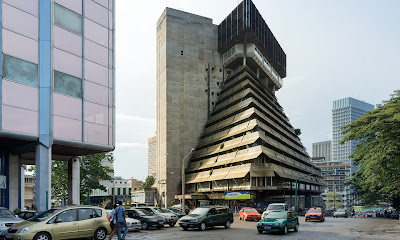
Photo by Iwan Baan of La Pyramide in Abadjan, Ivory Coast. The photo shows a large modern building made of concrete and shaped like half a pyramid attached to a tall rectangular tower. The building shows signs of disrepair.

Why do I bring this up in so lengthy a manner? Well it’s because of the values and ethics that are a part of solarpunk. Most people who are into solarpunk would agree that solarpunk societies are diverse and equal, free of prejudice and, not uncommonly, free of Western neo-capitalist ideals. That means that when designing and creating a solarpunk city, especially one that is not located in a European country, it is essential to examine the influences and origins of your design. If your design relies heavily on that of white Europeans for a city in central Africa then not only is it likely that it would be ill-suited stylistically and functionally but you would be ignoring the issue of colonialism and systemic racism. This is the case whether you are envisaging a potential real world future or creating new fictional spaces, because even fictional spaces are influenced by the real world.

In the case of Wakanda and Black Panther there is a thread running throughout the film (and I promise this is not a spoiler) that questions globalisation and colonialism and their impact on non-white, non-European countries. That the architectural design reflects this is a beautiful thing. It shows a level of awareness and consideration that is often neglected in solarpunk and sci-fi design (though I would bet good money on it rarely being left out of afro-futurism).

The modern, futuristic and high tech design of Wakanda does draw on the influence of non-African architects that’s for sure: as noted at the beginning there, Zaha Hadid was stated as a major influence and she was Israeli. But those designs have been chosen with consideration of the real world source material and what including those designs implies for a solarpunk dream city. In the cases where European designed buildings have been referenced they are those which have been embraced by current societies and have integrated themselves into modern cities and are still functional. To many of the 20thC brutalist structures were never completed or were abandoned when they proved unsuitable for their environment. Instead it is more recent architecture, both by African and non-African architects that has been referenced as modern African architecture is far closer to solarpunk ideals than its predecessors. It’s in African cities that you will see some of the most cutting edge uses of materials, inspiring design and forward thinking sustainable and eco-friendly building. Not only is that a part of the solarpunk ethos, it is the way of life of Wakanda.

Photo of the Leo Surgical Centre Designed by Francis Kere an architect from Burkina Faso. The image shows a wide walkway between rows of adjoining buildings the buildings have open roofs and wide overhangs.
That Bechler managed to integrate the traditional features and techniques with cutting edge design and modern and sci-fi technology is to be applauded. This is how Sci-fi and solarpunk cities should work. I wouldn't say it's how they should look because if there is anything you take away from this it's that solarpunk cities should be defined by their locale. But it is how they should be formed: seamlessly blending traditional and simple with new and high tech. Creating a city that is free of structural inequality and reflects the idealised social structure of your solarpunk world. In Wakanda the streets between the clay and vibrinium walls are wide and easy to pass through, there are no cars but plentiful public transport systems. there are places to sit and buildings can be entered into easily. The space is built for the people who live there and works with the environment around it to remove any social barriers whether they be from outside influence or physical ability. It is harmonious not just in society but in it's very structure. 

And that, is why Black Panther was an exciting film to watch for any solarpunk, architecture or afro-punk enthusiast. Ecologically smart, location sensitive novel design.

Still from Black Panther showing the mountain headquarters of the Jabari Tribe jutting out of the mountainside.
Included because it was my favourite piece of design.


[1] The simple living of farming war rhinos and defending the border.
[2] In the mid 20th Century several African nations had strong diplomatic relations with Israel which supported various anti-colonial and independence movements. The agreements were damaged in the 1970s due to the Arab-Israeli war, limiting foreign investment and development.

Thursday, 1 March 2018

The Sketchbook Project

The past few months I have been working on improving my drawing skills. In order to encourage myself to draw regularly I decided to participate in the Sketchbook Project.

Photograph of an A5 manila envelope with the heading "The Sketchbook Project" balanced on a person's knee with a tin of pencils balanced on top


This is a project set up in New York that aims to act as an archive and library of artists from beginner to professional. You simply fill up one of their sketchbooks, send it back to them and it becomes a part of their collection free for members of the public, schools, art and community groups to browse.
What I particularly like is that, while for me as a random member of the public I had to pay for the book, the sketchbook is sent free to schools and community groups who wish to participate. This makes art and participation n pubic arts projects far more accessible to low income people and not-for-profit groups. Greater accessibility to the arts is something I strongly support - art shouldn't always be treated as a luxury or as something only other people do. It should be something that all people regardless of background or current financial status feel they can be a part of.

photograph of an open text book on the left showing an upside down Picasso sketch and an open sketchbook on the left showing my pencil copy of the sketch

This, somewhat shaky and poorly filmed video gives you a walk through of my sketches, the things I have learned and how I have developed my drawing over the past few months. (video is subtitled in English)


If you like sketching or painting or want to do more art, I would definitely recommend considering getting a Sketchbook Project book to fill in and to contribute to the project. I found that being part of a bigger project was a really great motivation to pick up the book and draw even on days I might not have felt like it otherwise.