Showing posts with label solarpunk. Show all posts

Thursday, 1 November 2018

Let's talk about death

It being Halloween, All Hallows Eve, Samhain, Dia de los Muertos and so on, this seems like a good time to have a conversation about death and dying.

No, not the horrors of death, undead corpses walking around and spooky ghosts, but the actual realities of death and dying. For many people of different faiths and cultures, Halloween is more than an opportunity for costumes and scary films, it is a time where we consider grief and loss. There are often remembrances for the dead or the opportunity to accept loss and grieving and to move on. This ritual of being at peace with death and loss doesn't have to stop at others, it can extend to yourself too. Often this is metaphorical - saying goodbye to difficult circumstances or grieving a loss of self due to illness.
But maybe it can be more practical too. One of the many ways we can be more at peace with the concept of death in general and our own deaths in particular is toactually take time to think about what happens at the time. This doesn't just mean spiritual beliefs about the afterlife or what happens to a persons soul or spirit but can and should include practical considerations about how you physically want your death handled.

Ideally by considering these things and being open with loved ones about your own wishes you can encourage others to open up and talk about their wishes. While the thought of a loved one dying might be filled with sadness and fear, knowing what their beliefs are and what their wishes are can help to bring us to terms with their death (long) before the fateful day. If the only benefit is not having to worry about guessing at their wishes and making the practical aspect easier, that's still a weight off the shoulders of a grieving person.

In the therapy practice DBT this would probably be counted as the "coping ahead" skill in which a person visualises and works through a potentially distressing event in advance in order to lessen the impact of future feelings and to understand and cope with things which may be difficult.

But starting those conversations can be difficult. So let me go first.

I don't know what I believe about the afterlife. I am open to the concept of spiritual afterlives such as some non-Christian version of heaven. I don't really believe in reincarnation and I don't really believe in ghosts and the spirits of the dead haunting the living plane. I also don't believe that what you do to the body of the deceased impacts on any potential afterlife.

That doesn't mean I don't care what happens to my body. I actually do. I live my life in a manner which tries to be as environmentally friendly as possible within my circumstances and I would like that to be taken into account with what could be called my final act.

Ideally I would like to donate my body to medical science. I am also a registered organ donor. The process of donating your body to science happens long before you die. You have to submit a form or request to your chosen university of medicine giving your explicit consent while you are alive. It's not possible in most circumstances for somebody else to consent on your behalf after you have passed. If this is something you want then the earlier you arrange it the better. If you are in the UK can read the information on the Human Tissue Authority website. You will have to identify your local facility and contact them individually. I will be submitting a form to Leeds University as that is my local university. Should I move out of their "catchment area" then I will have to submit a form to whatever is the closest medical university there.
However, I also stated that I am an organ donor. Unfortunately this can be incompatible with donating your body to science. Medical researchers generally want whole bodies, so if your organs are donated after your death then the research institute may not be able to accept your body. There are other reasons they may not be able to take your body including some causes of death - each university has guidelines on what they can and can't accept. For this reason it's best not to leave your wishes at simply "donating to science".

image description: picture of a body wrapped in an unbleached linen shroud with yellow primroses resting on a wicker pallet. image from Respect Everybody Shrouds

I need a back up plan should my body not be accepted. For me there are a few considerations.
I specifically do not want to be embalmed and given a traditional British burial: the whole casket, 6ft down in a grave liner thing is not for me. It's too unnatural and too steeped in Christian traditions for me to be comfortable with. Embalming is also pretty nasty stuff. Sure I'll be dead and formaldehyde isn't going to harm me but it is a carcinogenic and there is the potential for harm to embalmers and also to wildlife and plant life should that fluid seep into the earth. Even worse, there have been cases of flooding in cemeteries which have washed that formaldehyde into our general water supply. Let's not do that.
So if I am to be buried I want it to be a natural burial without embalming and preferably in a shroud (I'm not going to lie if there is an eco friendly black option available, I'd love it) or all natural casket rather than the traditional big wooden box with all the fancy bits. This is usually called a Natural Burial or a Green Burial.


The other option I'd be interested in is sadly not licensed in the UK, but if it does become available before my death then it's super cool. It's called Alkaline Hydrolysis but is sometimes called "water cremation" or resomation. It's a process of essentially dissolving the body in an alkaline solution and then filtering the water. It's way more environmentally friendly than traditional cremation, though as it's less understood people are nervous about the thought of water filled with human remains. In reality this is cleaner than the smoke and vapour filled with human remains that gets pumped out of a crematory. My hope is that as it's talked about more people will become more comfortable with it and it will become legal in the UK. To be honest part of me likes this option because it has a slightly sci-fi feel to it.

image description: diagram of how an alkaline hydrolysis machine works showing a body in a cylindrical chamber. diagram from the BBC article "Dissolving the Dead"


And that's it. I have no specific wishes or requirements about funerals, wakes or memorials. I don't think that's up to me. That's something that is important to the living and I am happy to leave it to them to choose something that works for them and their grieving process. My concern is that my body is treated in a way that reflects my values. I would like my loved ones to know and be aware that they can be a part of this process if they want to be - if they want to prepare the body or be there at the burial or water cremation,  if they want a body that can be viewed. I want them to know that they have rights and some measure of control over how they mourn and deal with this event. It doesn't have to be completely taken out of their hands by a formal and clinical funeral home unless that's what they want. And a wake or memorial service can take place at any point and in any place they see fitting. That's ok with me.

I hope this helps you think about your own death in more positive or at least pragmatic terms. Let's start having these conversations and making death a less scary and incomprehensible thing.
There will always be sadness and grief around death and that's ok. But we don't have to make it harder on ourselves if we don't have to.

Thursday, 11 October 2018

Reconsidering the "Walkable City"


Based on previous posts (and chatter on facebook if you follow me there) you may be aware that I am interested in the concept of solarpunk and future cities. For those not initiated to the idea of solarpunk it is the concept of a better society that is built using modern (or future) science and is harmonious with the environment and with the people who live in it. If you read my post on Wakanda you will know my delight about a city that is not only environmentally sound, scientifically advanced but also people friendly and accessible and that’s a big deal.

The concept of walkable cities then, surely that fits into my solar punk future science ideal? Well yes and no. A recent article from the Guardian inadvertently provides the perfect example of this. The article itself is well written and well sourced with examples of a number of cities and studies but really the first indication of an issue is the title “a walkable city”. This name itself discounts large proportions of the population who can’t walk at all or easily. You could argue that the title isn’t specific but instead is referring to a concept. However the wording, as innocent it may be, directs people’s thoughts to walking and overlooking those that can’t walk.

A walkable city isn’t always about places being totally pedestrianised but the aim is for pedestrians to take priority and to be safe navigating on foot. The benefits are undoubted - lower levels of pollution, less collisions and accidents, better footfall and sales especially for small businesses. These are undoubtedly good things as is encouraging those who are able to to walk a little more to get more fresh air and be more active. But a potential benefit that is ignored is allowing disabled people to be more independent as well.

The article cites a number of cities and projects and the approaches they have taken. In London they have been using cameras and software to track the movement of cars, pedestrians and cyclists in order to determine the most efficient routes and road layouts to encourage more pedestrians. In Auckland the council have taken steps to make areas more “pedestrian friendly” by adding more trees and benches and removing car parking. Greater Manchester are creating “beelines” a joined up system of paths and cycle routes across their city to aid people walking from place to place and reducing the reliance on cars.

What is missing from all of these projects are considerations or even an acknowledgement of disabled people and the needs they may have or how their experiences may impact what counts as a “walkable” city.

Tracking footfall, bicycles and cars is a useful and important project and will certainly provide important information, however it only leads to an accessible city if those various pathways are wide enough for pedestrians and power chair or mobility scooter users. Trees and benches are great, especially providing seating for those who fatigue easily, but they must be placed in such a way that they don’t provide impediments to those who are blind or partially cited, and leave room for walking and chair based pedestrians alike to use the paths concurrently. Likewise for cycle and footpaths that span cities.
Creating pedestrian zones that allow easy walking is a wonderful idea but we also must recognise that walking across a city centre, even a walk of only a few hundred yards is impossible for some people. There still needs to be adequate disabled parking - and for there to be a cultural shift which doesn’t restrict them to only those who have been granted a Blue Badge (Blue Badges are often awarded based on your PIP award, since not everybody is awarded PIP no matter how high the need, this means people who need the badges may not have them).

But it goes even beyond that. According to some metrics York would be considered a “walkable city” by many. Much of the city centre is pedestrianised with limited traffic flow and priority given to pedestrians. This encourages a high percentage of thriving independent businesses. Anybody with mobility or other access issues would be quick to point out though, that it is most definitely not an accessible city. The streets are narrow and crowded, they are winding and uneven: a mix of narrow kerbs, cobbles, paving stones, sign-posts, bike racks and more. Getting around on foot with mobility issues is difficult: getting around in a chair is prohibitive. That’s even without addressing things like noise and visibility or the additional barrier of steps into buildings. A walkable city is not an accessible city and it’s very easy to end up with one at the cost of the other.

What frustrates me most about this article is how many of the project authors have been keen to consider inclusivity, for example Action Aid’s app and program to allow people to document streets and buildings they feel safe or unsafe in (and then hopefully passing that on to organisations that can make improvements). It quotes Susan Claris of Arup as saying “[a] huge indicator of a civilised walkable city” is safe public toilets. Clearly some thought and care is going into these studies. But what of people who don’t have access to a public toilet at all, safe or otherwise? Of the many public facilities across the UK (including over 4000 council run toilets) only a fraction of those are labelled accessible, fewer still are actually accessible (it’s not accessible if it’s also your storeroom) and even less are rated by Changing Spaces as suitable for an adult who needs a carer. In these pedestrianised walkable cities in which people aren’t able to dive into their car and speed home if caught short accessible toilets absolutely should be a priority.

Even worse in my eyes is that the article cites the “double buggy” test, being used by the Manchester project to determine if paths are wide enough that somebody could get a double pram down. That is important: parents and pushchairs should be thought about (and let’s not forget many of those parents may be disabled in someway themselves - using a double buggy instead of carrying a child may even be an accessibility adaptation for them) and it inadvertently helps disabled people - if a double buggy can get through so can the majority of mobility scooters, manual and power chairs. But nobody likes being an inadvertent afterthought, or in this case possibly not even an afterthought since we aren’t afforded the column inches by the journalist. It is significant because it would imply that the needs of disabled people aren’t being considered in these plans at all. If a double buggy can get down a path then yes a chair can too. But whereas a parent may be able to push a chair up or down a kerb, and over uneven surfaces or around awkwardly placed signs, a person in a power chair may not be able to and that’s just not a concern for these project builders.

Disabled people already struggle with getting out and about. But their absence from everyday public view on the streets of our cities isn’t because we don’t want to be there, it’s because of the barriers architects, councils, town planners and engineers have put in our way. The reason so many visionaries of future cities seem to have forgotten about us is because we are already kept out of site and out of mind by the societies we live in. Creating a fresh new walkable city or a city of the future is an admirable goal but if you look at your artists impressions and computer simulations and all you see are non-disabled people then you’ve gone wrong. You have neglected and discriminated against a large group of people who have every right to enjoy the businesses, places of work and attractions of a city with the same ease, safety and comfort as any other citizen disabled or not. That shouldn’t be forgotten about and it shouldn’t be reduced to an afterthought.

Truly revolutionary design and development comes by considering all the people who will be using your creation. Truly functional design that stands the test of time is something that can be embraced by the whole population and is fit for purpose, avoiding the need for decades of patching and re-engineering. That absolutely means considering the needs of everybody including disabled people.

So what of my shiny solarpunk dream cities? Would they be “walkable”? No. They would be accessible. Accessible to all who need to be there. For many that will mean safe and easy walking for others that will mean spaces and access routes for personal vehicles (electric and self driving of course, this is my dream after all). Streets that can be navigated with ease, clear road signs with braille or audio that can be picked up by a user’s app. Plenty of seating, and yes, good clean accessible toilets. Designated cycle lanes that don’t encroach on pedestrian space. Charging points for electric chairs and scooters. Smooth surfaces and ramps between different levels. Good lighting (reactive for energy efficiency and to reduce light pollution). Options and services for those people who need help carrying things (drones maybe?). Good public transport with easy access points and methods for getting into the centre of “pedestrian” spaces.

Yes some of these are out of our reach right now but many of them aren’t are are what I would think of as basic and minimal changes to a city to make it both accessible and pedestrian friendly. If the money can be spent on these existing projects then it can be spent on improving accessibility.

I don’t want to see any more think pieces on walkable cities. I want to see think pieces on accessible and inclusive cities. I don’t want to be erased from a future that hasn’t happened yet.

Amazingly, the Guardian has written on this subject themselves with an article called "What would a truly accessible city look like" from February 2018. They just must have forgotten about it. 

Wednesday, 21 March 2018

Wakanda - My Solarpunk Dream City

Or another reason to love Black Panther

At the time of writing Black Panther has been out at the cinemas for a good few weeks. It’s understandably got a lot of attention and most of it deservedly positive. Chances are, if you are reading this you have seen the film.

However this is not a Black Panther Review as such. This is me focussing on a very narrow aspect of the Black Panther themes and aesthetic. Because as well as the awesome representations, amazing female characters and strong ethical and moral themes, the entire design and concept of Wakanda was incredibly exciting especially to somebody who is a solarpunk and architecture nerd.

Screen-shot from Black Panther. the image shows a futuristic city from above surrounded by mountains. there are a number of skyscrapers of varying shapes and designs. The central tower has a large circular building spiralling around it.

About Solarpunk and Afro-Futurism

So to begin, let me just explain a little about solarpunk. Solarpunk is a movement, aesthetic and literary genre that embraces eco friendly, eco-integrated technology in a futuristic setting. It generally envisions a utopia or at least a functioning balanced society rather than a dystopia. At its most basic it is a style and aesthetic involving natural elements like plants, water, wind and sun alongside slick futuristic technology and building. More in depth it is an entire movement and way of thinking that people aspire to and is a goal to work towards not just in terms of technology but socio-politically envisioning a low impact society that provides opportunities and equality for all citizens.

Solarpunk is also closely tied to Afro-Futurism. Afro-Futurism is again simultaneously an aesthetic, a literary genre and a social movement. In brief it grew out of a desire to re-centre sci-fi away from white European style and social constructs. Authors from Africa were creating bold and beautiful sci-fi novels based on their own experiences and cultures and ignoring the “tradition” of sci-fi (and fantasy) being largely dominated by the white Western world which was heavily influenced by historic Europe. Additionally it seeks to draw on current and emerging technology and architecture from African countries. In doing so it challenges the narrative of “Africa” often seen in Western countries that tends to homogenise the entire continent and skim over the modern, functioning and often socially forward cities and countries in Africa focussing instead on wildlife, famine and seemingly less developed tribes.

Afro-futurism by its nature often encapsulates solarpunk ideals and aesthetics focusing on new technologies that work with or make use of natural resources in a sensitive and sustainable manner whilst respecting the cultures and needs of citizens.

So then to Black Panther or more specifically, Wakanda. If you have seen the film or to be honest just seen pro-mo pictures then you may by now have an inkling of why Wakanda and Solarpunk are related. The design of Black Panther’s Wakanda is down to Hannah Beachler, the head production designer for the film. As an aside, Beachler was strongly influenced by award winning architect Zaha Hadid and her iconic modernist designs who I happen to be a fan of. Beachler was also inspired by the Afro-futurist movement as well as the incredible real life modern and traditional architecture of a variety of African countries.

It’s worth noting that, while it’s generally not a good idea to refer to Africa in such a way as to imply one giant monolithic homogenous culture, in the case of Wakanda and Afro-futurism, it makes sense. Afro-futurism positions itself as thematically different to European sci-fi and is a pan-African phonemonon not restricted to any one country plus it deals in fictional creations. Additionally Wakanda itself being a fictional state which exists outside of colonialism and some may argue, represents a “heart” of Africa that brings together a number of different cultures and traditions. Essentially there is no single country to reference when talking about these subjects.

Seen through this context then it’s clear why the Wakanda on screen was a dream come true for an aficionado of Solarpunk or Afro-futurism. But it’s not just because it looks pretty, though it certainly does. The real excitement, for me at least, was the variety and thoughtfulness of the design.

Considering your environment

Solarpunk art often falls into the trap of envisioning the same soaring towers of class and metal alloys covered in plants, solar cells and wind turbines. Accasionally you get some divergence to stucco covered Gaudi like organic structures that sweep and curve around a city. This is a trap because it is missing some of the core ideals of solarpunk design and ethos – that people should live a live which is both in harmony with the world around us as well as living in a sustainable and equal society. The thing is, every environment, country, ecosystem and area is going to have very different needs when it comes to living that solarpunk life. At its most simple we can see this in everyday housing design. Most people in Queensland, Australia for example have houses built to maximise ventilation and minimise glare from the sun. Many houses don’t have any real sort of heating system because it’s simply not needed and insulation would not only be a waste of money but could lead to dangerous overheating. Put that house design in the UK and you are going to have cold, damp unhappy residents. Here we need buildings with thick walls, plenty of insulation, large south facing windows to maximise light and smaller north facing windows to stop us getting chilly – though we do share the need for ventilation to prevent endless damp.

Futuristic architecture and sci-fi technology doesn’t do away with this need to be cognizant of our surroundings and in solarpunk I would say the need is even greater if we want to achieve the near utopian levels of harmony the genre aspires to. But while this is where some solarpunk falls down, it’s where Beachler’s design excels. By drawing on existing architecture and emerging African technologies for her design, she created a Wakanda that works well and integrates into its environment with harmony.

The Importance of Traditional Buildings

Traditional architecture is generally a good place to start to look for simple architectural techniques that make the most of the environment, and this is no different in Africa. In Wakanda this is most obviously seen in the village of the Border Tribe who mostly live and work out of what would be recognised as “traditional” houses made of mud and wattle with thatched roofs. The buildings are cylindrical with conical roofs – similar to those found in Rwanda, Lesotho, Kenya and many other areas - and small windows. They keep the daytime heat out and keep you warm at night. But traditional design isn’t restricted to the “simple living” of the Border Tribe[1], its influence is in the central city as well.


Still from Black Panther. Image shows a bustling street view looking down a wide road. There is a futuristic road-train in he centre, the buildings are varied in size and material.
There are a number of buildings in the city that would appear to be made out of mud or clay walls albeit finished with more modern or technologically advance roofing. In other areas of Africa, for example Ghana and Mali, a number of traditional buildings are made from sweepings curves with mound shaped columns supporting the walls and roofs. They are incredible and beautiful structures, made of ingenious shapes that make the most of natural resources. Tin some cases these walls and towers are strengthened by horizontal beams and rods that project through the outer surface making them bristle like a hedgehog. Again these basic shapes and materials make their way into the fantastic and solarpunk Wakanda on screen.

A close up photo of an ancient mosque in Ghana. The building as tall mound shaped pillars with wooden spurs protruding through the clay.

This integration of traditional techniques, using local materials and building methods that are sympathetic to the local environment in order to reduce overall impact is an essential part of solarpunk design and one that is often over looked.

Modern Architecture is Complex

All that being said, Africa isn’t a continent made up solely of traditional buildings and basic living. Like any other continent on Earth it has its share of modern cities and busy urban spaces. Here we need to consider the general history of Africa and how it fits in to modern institutional racism and what that means for solarpunk. Large parts of Africa were invaded and colonised by European countries. Many of the borders we recognise today were not “naturally occurring” (if any can be said to be) but the result of colonial intervention and war. Additionally architectural styles from the 19thC onwards have been heavily influenced by European settlers as well as mass globalisation and the spread of capitalism. European settlers had specific ideas about what houses and buildings looked like, and though their usual stone and brick wasn’t available they strove to recreate this facsimile of European architecture in the land they had colonised. This wasn’t always successful; as noted these building designs aren’t always suitable for the local conditions.

However it wasn’t all a disaster and fairly quickly European building design was adopted. The rapid increase in global markets and the post-colonial atmosphere of the mid 20th Century accelerated building and development of cities. What was peculiar was the flourishing architectural style of many African cities was still dominated by white European or Israeli[2] architects. Rapidly developing African countries where the perfect setting for radical brutalist and modernist designs of the 50s and 60s. While this undoubtedly fit in with the psyche and mood of the time it does mean that a lot of the modern African architecture that is held in high esteem has a complex history in which it is the product of post colonial colonialism. Indeed for a period there was a lack of non-white “modern architects” as opposed to merely people who build buildings, who originated from African countries as those subjects weren’t taught widely outside of European universities and/or there was segregation acting as a barrier.
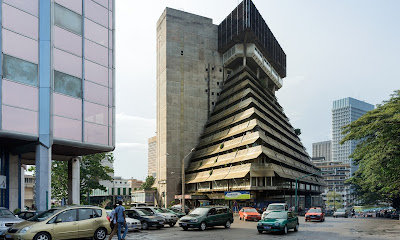
Photo by Iwan Baan of La Pyramide in Abadjan, Ivory Coast. The photo shows a large modern building made of concrete and shaped like half a pyramid attached to a tall rectangular tower. The building shows signs of disrepair.

Why do I bring this up in so lengthy a manner? Well it’s because of the values and ethics that are a part of solarpunk. Most people who are into solarpunk would agree that solarpunk societies are diverse and equal, free of prejudice and, not uncommonly, free of Western neo-capitalist ideals. That means that when designing and creating a solarpunk city, especially one that is not located in a European country, it is essential to examine the influences and origins of your design. If your design relies heavily on that of white Europeans for a city in central Africa then not only is it likely that it would be ill-suited stylistically and functionally but you would be ignoring the issue of colonialism and systemic racism. This is the case whether you are envisaging a potential real world future or creating new fictional spaces, because even fictional spaces are influenced by the real world.

In the case of Wakanda and Black Panther there is a thread running throughout the film (and I promise this is not a spoiler) that questions globalisation and colonialism and their impact on non-white, non-European countries. That the architectural design reflects this is a beautiful thing. It shows a level of awareness and consideration that is often neglected in solarpunk and sci-fi design (though I would bet good money on it rarely being left out of afro-futurism).

The modern, futuristic and high tech design of Wakanda does draw on the influence of non-African architects that’s for sure: as noted at the beginning there, Zaha Hadid was stated as a major influence and she was Israeli. But those designs have been chosen with consideration of the real world source material and what including those designs implies for a solarpunk dream city. In the cases where European designed buildings have been referenced they are those which have been embraced by current societies and have integrated themselves into modern cities and are still functional. To many of the 20thC brutalist structures were never completed or were abandoned when they proved unsuitable for their environment. Instead it is more recent architecture, both by African and non-African architects that has been referenced as modern African architecture is far closer to solarpunk ideals than its predecessors. It’s in African cities that you will see some of the most cutting edge uses of materials, inspiring design and forward thinking sustainable and eco-friendly building. Not only is that a part of the solarpunk ethos, it is the way of life of Wakanda.

Photo of the Leo Surgical Centre Designed by Francis Kere an architect from Burkina Faso. The image shows a wide walkway between rows of adjoining buildings the buildings have open roofs and wide overhangs.
That Bechler managed to integrate the traditional features and techniques with cutting edge design and modern and sci-fi technology is to be applauded. This is how Sci-fi and solarpunk cities should work. I wouldn't say it's how they should look because if there is anything you take away from this it's that solarpunk cities should be defined by their locale. But it is how they should be formed: seamlessly blending traditional and simple with new and high tech. Creating a city that is free of structural inequality and reflects the idealised social structure of your solarpunk world. In Wakanda the streets between the clay and vibrinium walls are wide and easy to pass through, there are no cars but plentiful public transport systems. there are places to sit and buildings can be entered into easily. The space is built for the people who live there and works with the environment around it to remove any social barriers whether they be from outside influence or physical ability. It is harmonious not just in society but in it's very structure. 

And that, is why Black Panther was an exciting film to watch for any solarpunk, architecture or afro-punk enthusiast. Ecologically smart, location sensitive novel design.

Still from Black Panther showing the mountain headquarters of the Jabari Tribe jutting out of the mountainside.
Included because it was my favourite piece of design.


[1] The simple living of farming war rhinos and defending the border.
[2] In the mid 20th Century several African nations had strong diplomatic relations with Israel which supported various anti-colonial and independence movements. The agreements were damaged in the 1970s due to the Arab-Israeli war, limiting foreign investment and development.